
The Seventy Weeks Prophecy of Daniel
This is The Backbone of all Bible Prophecy
Daniel 9:20–27
20 And whiles I was speaking, and praying, and confessing my sin and the sin of my people Israel, and presenting my supplication before the Lord my God for the holy mountain of my God; 21 Yea, whiles I was speaking in prayer, even the man Gabriel, whom I had seen in the vision at the beginning, being caused to fly swiftly, touched me about the time of the evening oblation. 22 And he informed me, and talked with me, and said, O Daniel, I am now come forth to give thee skill and understanding. 23 At the beginning of thy supplications the commandment came forth, and I am come to shew thee; for thou art greatly beloved: therefore, understand the matter, and consider the vision. 24 Seventy weeks are determined upon thy people and upon thy holy city, to finish the transgression, and to make an end of sins, and to make reconciliation for iniquity, and to bring in everlasting righteousness, and to seal up the vision and prophecy, and to anoint the most Holy.25 Know therefore and understand, that from the going forth of the commandment to restore and to build Jerusalem unto the Messiah the Prince shall be seven weeks, and threescore and two weeks: the street shall be built again, and the wall, even in troublous times. 26 And after threescore and two weeks shall Messiah be cut off, but not for himself: and the people of the prince that shall come shall destroy the city and the sanctuary; and the end thereof shall be with a flood, and unto the end of the war desolations are determined (ASV,1901).
Daniel has been reading the book of Jeremiah and probably the book of Isaiah. He sees that the length of the Babylonian captivity is going to be only seventy years, and is due to expire. Part of Daniel’s prayer shows he knows that Israel has to confess her national sins before the Messiah is going to come to set up His kingdom. Following the prayer, the angel Gabriel comes to make a correction to Daniel’s assumption about when the kingdom would begin. Gabriel tells Daniel that the kingdom is going to be set up after this concept he introduces called, “the Seventy-Sevens”. Daniel thought waiting for seventy years to finish would be the time span, and Gabriel says, “No, no… it’s seventy-sevens of years.”
In verse 24, the English word translated as “weeks” in Hebrew is shavuim (Strong’s H7620). The English translators translated it as “weeks”, possibly because a week has seven days. It is a mis-translation. It should be translated as “seventy-sevens”, not “seventy weeks”. Shavuim refers to “seven of something”, much like we refer to a “few” as referring to 3 of something. So, in this passage it refers to 490 years. The purpose of the 490 years is to accomplish six things:
- To Finish the Transgression. The first purpose of the 490 years is to bring the Jewish people’s sin, their “transgression”, under control so that they will no longer reject their Messiah. In the New Testament Paul tells us this same thing in Romans 11:26, that all Israel will be saved. The statement “all Israel shall be saved” in verse 26means that the majority of Jews in the final generation before Christ’s return will turn to Christ for salvation. This underscores Paul’s clear intention to demonstrate that God had not rejected Israel and be restored to God.
- To Make an End of Sins. The second purpose of the 490 years is to make and end of sins (in the plural), which means to prevent the Jews from sinning or “missing the mark” in their daily life.
- To Make Reconciliation for Iniquity. This third purpose called “reconciliation” here actually means “atonement” in the Hebrew language (Strong’s H3722). This is the means by which the sinning will stop.So, this program of the Seventy-Sevens will remove the national sin of rejecting the Messiah, stop their daily sinning, and “turn off” the sin nature of the Jews so they are not even inclined to sin.
- To Bring in an Age of Righteousness. The fourth purpose of these seventy-sevens is to bring in the Kingdom age, which is what the Hebrew word translated as “everlasting” (H5769) means.Other Old Testament passages that give us this same information are Isaiah 1:26; 11:2-5; 32:17; Jeremiah 23:5-6; and Jeremiah 33:15-18. Daniel thought it would happen right away. But Gabriel corrected him and told him it will be another 490 years, and this gives a starting point from which to start counting the years. The beginning point is not right after the end of the seventy years of captivity. It will actually occur after seventy sevens of years or 490 years.
- To Cause a Cessation of Prophecy. This particular issue addresses the final fulfillment of both oral and written prophecy. To cause a cessation of prophecy actually means to stop the oral prophecies, such as those of Elijah or Elisha, and the written prophecies, such as those of Isaiah and Jeremiah. The Bible is “a closed” cannon, so to speak, and this is what it addressed to here. There will not be any more prophetic writings in the Bible.
- To Anoint the Most Holy Place. This final purpose of the seventy-sevens is to anoint a most Holy Place. This will take place in the fourth temple or the Temple of the Messianic Kingdom, which will be built by the Lord Himself. It will be the Millennial Temple that will last for 1,000 years.
The statement of Gabriel refers to some event he called the commandment to restore and to build Jerusalem. Jerusalem had been ruined by Nebuchadnezzar’s last invasion of 586 B.C.
It was officially given in the 20th Year of Artaxerxes (c. 445–444 BC): Recorded in Nehemiah 2, where the king explicitly granted Nehemiah permission and official paperwork to rebuild Jerusalem’s protective walls, gates, and streets.
The following chart shows a time line that begins on March 14, 445 B.C. when the command given to rebuild Jerusalem came from Artaxerxes Longimanus.
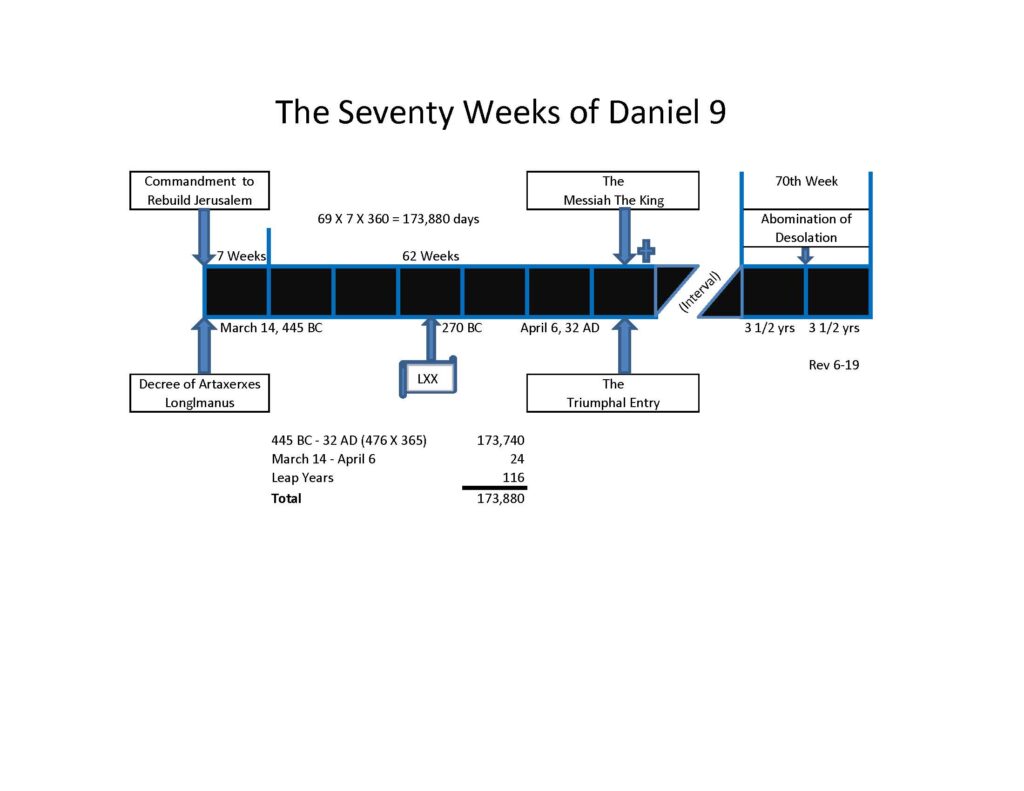 Source: Daniel E. Woodhead
We see where the first seven-week period of 49 years elapses. The first sub-division begins with Nehemiah returning to Jerusalem to rebuild the city in very difficult times as the book of Nehemiah recounts the events. It took forty-nine years to finish, or one “seven”. The second subdivision immediately begins after the first seven ends. There is no particular sign for the second sub-division to begin or to start. There is no break between them.
Adding the first seven “sevens” (49 years) to the next segment of sixty-two “sevens” (434 years) give us a total of 483 years that will elapse from the decree of Artaxerxes Longimanus to the coming of Messiah the Prince. Seen in the gospels that Jesus frequently would not allow the population of Jerusalem to declare Him the Mashiach Nagid, the Messiah the Prince, or the Messiah the King until the day we call “Palm Sunday”. Every time they got close to Him to praise Him, He left, or disappeared. He could not let them do that for He knew that the title of King or Prince could only be used on a specific day.
This segment of 62 weeks runs to April 6, 32 A.D. That is the date Jesus rode into Jerusalem on the back of a colt on Palm Sunday, also called “His Triumphal Entry”. The people were praising Him and singing Hosanna, saying, “Blessed [be] the King that cometh in the name of the Lord.” The prophecy is very exact. It works out to be 173,880 days. So, the first 483 years of the total 490 years came to an end with the first coming of the Messiah.
There is a break in time between the 69th and 70th week. We are not told how long this break period will last. Prior to the break in time, the second subdivision finishes up with the Messiah’s first coming and the interlude of time begins. At the end of this interlude, the last 7 years or the 70th “sevens” will have a recognizable starting point. This last subdivision begins with the signing of a covenant between the Antichrist (called “the prince” in Daniel 9:26) and the Jews. It is the signing of that covenant that ends the interlude and begins the 7-year Great Tribulation. The church is born between 69thand the 70th sevens.
The Covenant with the Antichrist- The Starting Point for the 70th Week.
In Daniel 9:27, the covenant is stated to be with “the many”, not with just “many”. This is the leadership of Israel who will be empowered to sign this covenant. The covenant is being made for the seven years. At that time, the leaders of Israel do not realize that it will only be for seven years, which is the length of the Great Tribulation.
Daniel 9:27
27And he shall make a firm covenant with many for one week: and in the midst of the week he shall cause the sacrifice and the oblation to cease; and upon the wing of abominations shall come one that maketh desolate; and even unto the full end, and that determined, shall wrath be poured out upon the desolate (ASV, 1901).
While Daniel 9:27 presents the covenant that begins the Great Tribulation from man’s perspective, Isaiah 28:14–23 views the covenant from God’s perspective.
Isaiah 28:14-15
14 Wherefore hear the word of Jehovah, ye scoffers, that rule this people that is in Jerusalem: 15 Because ye have said, We have made a covenant with death, and with Sheol are we at agreement; when the overflowing scourge shall pass through, it shall not come unto us; for we have made lies our refuge, and under falsehood have we hid ourselves (ASV, 1901)
Verse 14 reveals God’s viewpoint of “the many” who enter the covenant, He considers them “scoffers”, or mockers rather than serious leaders. Verse 15 provides God’s viewpoint of them and of the covenant itself. It is obvious why God calls the leaders “scoffers”. It is because the leaders of Israel will enter into this covenant in order to obtain security and to escape the “overflowing scourge”. They know who the Antichrist is, but think this covenant will make them immune from what is coming on the world. The figure of a flood, used symbolically here, represents a military invasion. Hence, the leaders of Israel will believe that by entering the covenant, they will be protected from any invasion and believe the Antichrist’s lies. However, God declares that this is not a covenant of life, but a “covenant with death”. It is not a covenant of heaven, but a covenant of hell. Rather than gaining security, they will receive a large measure of insecurity.
Verse 16 addresses the who refuse to enter into the covenant:
Isaiah 28:16
16Therefore thus says the Lord Jehovah, Behold, I lay in Zion for a foundation a stone, a tried stone, a precious corner-stone of sure foundation: he that believes shall not be in haste (ASV, 1901).
From this verse God is saying that He knows that there will be a segment of Jews, as there were in Daniel 9:27, who will refuse to have anything to do with this covenant. They will not enter into it quickly, nor identify themselves with it. They are probably pressured by the other leaders to quickly sign this agreement. They are in direct contrast with the nobles who are relying on insecure refuge and a false ground of confidence in the Antichrist. The Lord lets them know who is the one sure rock, or “stone”, on which complete dependence may be placed. He declares that Jehovah has laid in Zion “a stone, a tried stone, a precious corner-stone of sure foundation” already. Jesus is “a tried stone, a precious corner stone, a sure foundation”. The imagery is drawn from the practice of Oriental kings, and even Solomon, who used foundation-stones of enormous size and weight at the corners of buildings. Some of those uncovered at the corners of Solomon’s temple and Herod’s extension are more than thirty-eight feet long, and weigh over a hundred tons. But the reference is not to a simple stone of the temple as Israel’s true refuge. Rather, Jesus Himself is the “stone”. This is also the reference to Christ by the writers of the New Testament, and appropriately describes Christ’s efficacy (Romans 9:33; Ephesians 2:20; 1 Peter 2:6–8).
Then, in verses 17–22, the same three results are found as in Daniel 9:27. First, in verses 17–18, the covenant is broken followed by the military invasions they hoped to escape:
Isaiah 28:17–18
17And I will make justice the line, and righteousness the plummet; and the hail shall sweep away the refuge of lies, and the waters shall overflow the hiding-place. And your covenant with death shall be annulled, 18and your agreement with Sheol shall not stand; when the overflowing scourge shall pass through, then ye shall be trodden down by it (ASV, 1901).
Plus, in verses 19–20, massive grief will fall upon the Jewish people:
Isaiah 28:19–20
19As often as it passes through, it shall take you; for morning by morning shall it pass through, by day and by night: and it shall be nought but terror to understand the message. 20For the bed is shorter than that a man can stretch himself on it; and the covering narrower than that he can wrap himself in it (ASV, 1901).
Rather than having security, they will have insecurity. This insecurity is pictured as tremendous mortification, or humiliation and shame, and is illustrated in two ways. First, it is like a man trying to stretch himself out on a bed that is too short for him. Second, it is like a man trying to wrap himself up in a blanket to protect himself from the cold, but the blanket is too small to cover all of his body. In place of comfort, there will be discomfort. In place of security there will be insecurity.
The third result is the wrath of God, emphasized in verses 21–22:
Isaiah 28:21–22
21For Jehovah will rise up as in mount Perazim, he will be wroth as in the valley of Gibeon; that he may do his work, his strange work, and bring to pass the act, his strange act. 22Now therefore be ye not scoffers, lest your bonds be made strong; for a decree of destruction have I heard from the Lord, Jehovah of hosts, upon the whole earth (ASV, 1901).
In verse 21, the Lord names two geographical sites where His might was evident in the battles King David fought there. Mount Perazim is mentioned in Isaiah 28:21, apparently near “Baal-perazim, the “Baal of Breaches, where David defeated the Philistines. From the context of 2 Samuel 5:20, this battleground was evidently located in the Valley of Rephaim, southwest of Jerusalem” (Elwell & Beitzel, “Perazim, Mount”, 1988, 1641). “This victory is connected with another over the same nation in the valley of Gibeon (1 Chronicles 14:13–16). Now, however, God was to be on the side of the enemies of His people, who were to suffer as the Philistines had suffered in the olden times.
Two of the Old Testament phrases for the Great Tribulation are given in verse 21, and they are “his strange work” and “his strange act”. This punishment of His own people by the sword of foreigners was “strange work” on God’s part, meaning a strange act. But it was their strange conduct which caused God’s strange action. They had become, as it were, Philistines” (Spence-Jones, 1910, 450-451). These two phrases are unusual because of the latter phrase in verse 22, “for a decree of destruction have I heard from the Lord, Jehovah of hosts, upon the whole earth.” This decree is issued in heaven because of the covenant that is signed on earth. It is “strange” in that it calls for the destruction of the whole earth. This decree of destruction is the same as the seven-sealed scroll of Revelation chapter five, which the Lord Jesus opens one seal at a time in chapter six. In Revelation chapter six, there is massive destruction of the earth causing the death of nearly two billion people with the breaking of these seals. But this decree of destruction will be issued only when the covenant is signed. So then, the same point made in Daniel 9:27 is made by Isaiah. The Great Tribulation begins with the signing of the seven-year covenant between the leaders of Israel and the Antichrist. Once that covenant is signed, the Great Tribulation begins, and a decree of destruction is issued by God Himself. One can only imagine Isaiah’s thoughts as the Lord revealed these far future events to him.
Hear and Listen
Isaiah 28:23
23Give ye ear, and hear my voice; hearken, and hear my speech (ASV, 1901).
God first begins by calling the people to listen to what He has to say. The prophet cordially begins to alert the nation Israel by making four direct requests. Isaiah strongly emphasizes and repeats this call by using four independent statements. His emphasis comes from the fact that the scoffers confronted in the previous verses have been continuously mocking his prophetic message which are directly from God’s Word. The four requests are:
- “Give ye ear”
- “Hear my voice”
- “Hearken”, or give respectful attention to
- “Hear my speech”
A preface like this in a kind manner required special attention and thought, and was appropriate when instruction was to be presented in a parabolic form. There are at least three other examples of this request voiced for the people to pay attention. They are mostly found in the Old Testament wisdom literature and the prophets:
Psalm 49:1–4
1Hear this, all ye peoples; Give ear, all ye inhabitants of the world, 2Both low and high, Rich and poor together. 3My mouth shall speak wisdom; And the meditation of my heart shall be of understanding. 4I will incline mine ear to a parable (ASV, 190, underlining added1).
Psalm 78:1–4
1Give ear, O my people, to my law: Incline your ears to the words of my mouth. 2I will open my mouth in a parable; I will utter dark sayings of old, 3Which we have heard and known, And, our fathers have told us. 4We will not hide them from their children, Telling, to the generation to come the praises of Jehovah, And, his strength, and his wondrous works that he hath done (ASV, 1901, underlining added).
Hosea 5:1
1Hear this, O ye priests, and hearken, O house of Israel, and give ear, O house of the king; for unto you pertaineth the judgment; for ye have been a snare at Mizpah, and a net spread upon Tabor (ASV, 1901, underlining added).
Similarly, in the New Testament Jesus declares to each of the seven churches of Asia:
“He that hath an ear, let him hear what the Spirit saith to the churches” (Revelation 2:7, 11, 17, 29; 3:6, 13, 22, underlining added).